Small businesses are often told they need search engine marketing, local SEO, content, a better website, AI search optimization, analytics, and more. The confusing part is not whether these services can help. It is knowing which ones matter for your business right now, and how local search marketing, SEO, and AI visibility should work together.
Search marketing services help a business become easier to find, understand, trust, and choose across Google Search, Google Maps, AI-powered search tools, and its own website. The best strategy is rarely a disconnected list of tactics. It is a focused system built around how your customers actually search.
This guide explains the core search marketing services Viking Search Marketing provides, what each one does, and how a small business can prioritize the right work without paying for unnecessary agency overhead.
What are search marketing services?
Search marketing services improve the ways customers discover and evaluate a business online. They can include traditional search engine optimization, local visibility, Google Business Profile management, AI search readiness, website improvements, content strategy, and performance measurement.
Each discipline has a different role:
SEO helps search engines crawl, understand, and rank your website.
Local SEO helps nearby customers find your business in local results.
Google Business Profile optimization improves your presence in Google Search and Maps.
AI search optimization makes your business easier for answer engines and AI assistants to interpret and reference.
Website strategy turns visibility into a useful, trustworthy customer experience.
Content strategy answers the questions customers ask before they contact or buy.
Analytics shows what is working and where the next opportunity may be.
A business may not need every service at the same intensity. It does need a clear foundation and a plan that connects the right channels.
The search marketing services most small businesses actually need
1. A sound SEO foundation
SEO begins with making sure search engines can access, understand, and confidently present your website. That includes fundamentals such as:
Crawlability and indexation
Logical site structure
Clear page titles and descriptions
Useful service pages
Internal links
Mobile usability
Page performance
Structured, trustworthy content
An SEO audit and strategy helps identify which technical, content, and structural issues are limiting visibility. It also prevents a business from spending time on lower-priority tactics while larger problems remain unresolved.
Strong SEO is not about stuffing keywords into every page. It is about making the site useful for customers and unambiguous for search systems.
2. Local SEO for businesses that serve defined areas
If customers choose a provider based partly on location, local SEO should be central to the strategy. This applies to storefronts, professional services, contractors, healthcare practices, home-service businesses, and many other organizations serving specific communities.
Local SEO services may include:
Location and service-area optimization
Consistent business information
Local service pages
Review strategy
Local citations
Google Maps visibility
Local competitor analysis
Content aligned with regional search intent
Local SEO helps connect what a business offers with where it offers it. That context is important to customers, traditional search engines, and newer AI discovery tools.
3. A complete and actively managed Google Business Profile
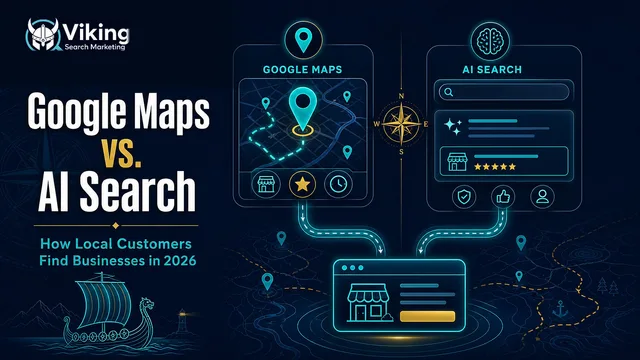
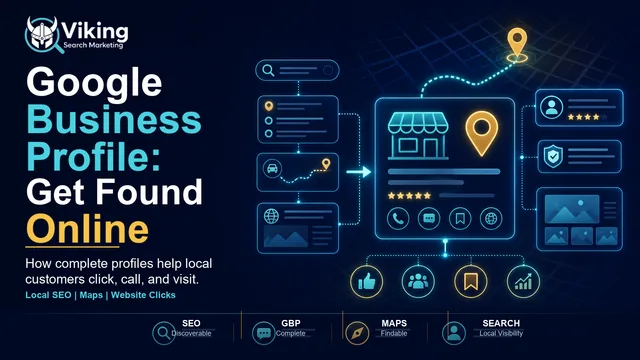
For many local searches, customers encounter the map results before they visit a traditional website. A Google Business Profile can show services, reviews, photographs, business hours, contact options, directions, and important updates directly within Search and Maps.
Google Business Profile creation and optimization should focus on accuracy, completeness, relevance, and ongoing maintenance. Categories, services, descriptions, images, reviews, and business details all contribute to how well the profile represents the business.
A website still matters. The profile and website support each other. The profile can create the first impression, while the website provides deeper proof and helps the customer take the next step.
For a closer look at that relationship, see How a Google Business Profile Helps Customers Find You Online.
4. AI search readiness built on reliable information
Customers increasingly use AI-generated answers, summaries, and conversational tools while researching businesses. This does not mean small businesses should abandon SEO or chase every new acronym. It means their information must be clear, consistent, and easy for different systems to interpret.
AI search optimization services can strengthen:
Clear descriptions of services and locations
Direct answers to common customer questions
Entity and brand consistency
Credibility and trust signals
Structured content
Helpful comparison and decision content
Alignment between the website, listings, and third-party references
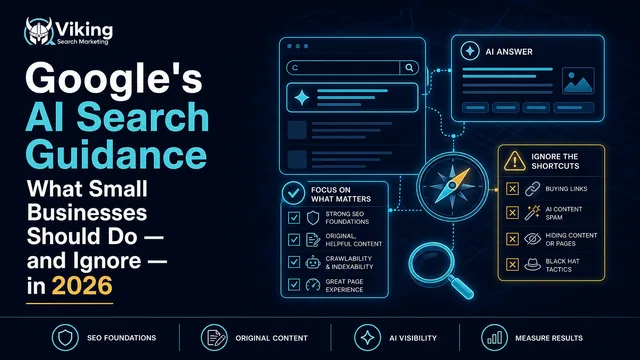
AI search readiness works best as an extension of good SEO, not a replacement for it. Google's own direction continues to emphasize useful content, accessibility, and sound search fundamentals. Our guide to Google's AI search guidance for small businesses explains what deserves attention and which shortcuts are better ignored.
5. A website designed to convert attention into action
More traffic does not automatically create more leads. Once customers reach a website, they need to understand what the business offers, who it serves, why it is credible, and what to do next.
Website optimization may include:
Clear service positioning
Strong page hierarchy
Accessible typography and contrast
Mobile-friendly layouts
Focused calls to action
Trust-building proof
Faster load times
Forms that are easy to complete
Landing pages aligned with campaigns and search intent
For businesses using Wix, Wix SEO and website strategy can connect design improvements with search visibility and conversion goals. The platform itself is only part of the equation. The structure, messaging, usability, and strategy determine whether the site does its job.
6. Content that answers real customer questions
Good content should help a customer make a decision. That may mean explaining a service, answering a common concern, comparing options, demonstrating experience, or clarifying what happens next.
A practical content strategy can include:
Detailed service pages
Local landing pages
Frequently asked questions
Helpful blog articles
Case studies
Process explanations
Comparison content
Original research or professional observations
The goal is not to publish as often as possible. It is to build the most useful set of answers around the questions your best customers are already asking.
7. Analytics that guide decisions
Measurement keeps search marketing connected to business outcomes. Rankings can be useful, but they are not the only signal that matters.
Depending on the business, useful measurements may include:
Search impressions and clicks
Google Maps actions
Qualified form submissions
Calls and appointment requests
Landing-page engagement
Conversion rates
Indexed pages
Branded and non-branded search growth
Leads connected to particular services
Analytics should help answer a practical question: What should we improve next? Reports that generate activity without clarity are not a strategy.
How these services work together
Search marketing is strongest when each part reinforces the others.
A well-structured service page gives Google clearer information to index. That page can support a Google Business Profile service listing. Reviews and consistent local information add trust. An FAQ can answer customer questions while helping AI systems interpret the service. Internal links connect related topics. Analytics then shows which pages and queries are attracting attention.
This is why isolated tactics often disappoint. A technically healthy website with vague content may not convert. A strong Google Business Profile linked to a weak website can lose customer confidence. Excellent content that is buried in poor site architecture may never earn meaningful visibility.
The objective is not to do everything at once. It is to identify the most important constraint and build outward from there.
A recent client example
A recent client came to Viking Search Marketing with several pieces already in place. The business had a website, service information, and a clear reason customers should choose it. The problem was that those pieces did not work together.
Important services were difficult to find. Page headings did not consistently match customer language. Internal links were limited. The site's calls to action varied from page to page, and the local and AI-search signals were not clearly connected to the core offering.
The solution was not simply to publish more content. We first clarified the site's structure and priority services. We improved page messaging, strengthened internal connections, created clearer paths toward conversion, and aligned the content with traditional search, local discovery, and AI-assisted research.
That example is intentionally anonymous, but the lesson is widely applicable: search visibility usually improves through coordinated decisions, not a single trick.
How to prioritize the right search marketing work
A small business can use four questions to decide where to begin:
Can search engines access and understand the website? If not, start with technical and structural SEO.
Do customers search for the business by location? If yes, prioritize local SEO and Google Business Profile work.
Does the website clearly explain the offer and create confidence? If not, improve service pages, usability, and conversion paths.
Are customers asking questions the current content does not answer? If yes, build useful content around those decisions and concerns.
A focused audit should identify the biggest opportunity and the order in which improvements should happen.
What small businesses usually do not need
Many businesses do not need a large retainer covering every available marketing service. They also do not need:
High-volume content created without a clear purpose
Constant redesigns that ignore performance
Reports filled with metrics but no recommendations
AI-generated pages published without review
Separate strategies that compete for attention
Complex campaigns before foundational problems are fixed
A leaner approach can be more effective: senior strategy, a clear roadmap, and the right specialists brought in when the work calls for them.
Choosing a search marketing partner
Look for a partner who can explain priorities in plain language and connect recommendations to customer behavior. Good questions to ask include:
What problem should we solve first?
How will this work support leads or sales?
Which services do we not need right now?
How will SEO, local visibility, AI search, and the website support one another?
What will be measured?
Who will actually perform the work?
The right relationship should create clarity. It should not make search marketing feel more mysterious.
Frequently asked questions
What is the difference between SEO and search marketing?
SEO focuses on improving organic search visibility. Search marketing is a broader strategy that can include SEO, local search, Google Business Profile optimization, content, website improvements, AI search readiness, analytics, and sometimes paid search. At Viking Search Marketing, the emphasis is on organic and discovery-focused channels working together.
Does every small business need local SEO?
No. Local SEO is most important when customers search for a provider in a specific city, region, or service area. A national ecommerce or fully remote business may need a different emphasis, although location and trust signals can still matter.
Is AI search optimization separate from SEO?
Not entirely. AI search readiness builds on many of the same foundations as SEO: clear information, useful content, strong site structure, credibility, and consistent business details. It adds an emphasis on direct answers, entity clarity, and content that AI systems can interpret accurately.
How long does search marketing take?
The timeline depends on the site's condition, competition, market, and work required. Some improvements can affect usability or conversions quickly. Organic visibility generally develops over time as search engines recrawl pages, understand changes, and evaluate the site's authority.
Should a small business hire an agency or a consultant?
It depends on the scope. Some businesses need one experienced strategist. Others need a coordinated group of specialists. The important thing is having clear senior ownership and bringing in the right expertise without paying for resources the project does not require.
Start with clarity
You do not need to choose between every search marketing service before you understand the problem. Start by identifying how customers currently find the business, where the journey breaks down, and which improvements can create the most meaningful progress.
The Free Visibility Snapshot provides an initial look at website visibility, local search, Google Business Profile performance, content quality, technical basics, and AI readiness. It is a practical way to see which part of your search marketing system deserves attention first.