If you added FAQ schema to your website hoping for the little expandable question-and-answer dropdown in Google search results, that feature is gone. Google quietly discontinued FAQ rich results in 2026, and it caught a lot of site owners off guard. Here is what actually changed, and why your FAQ content itself is not one of the things you need to worry about.
What Actually Changed
According to Google's own Search Central documentation, the FAQ rich result feature “is no longer shown in Google Search results,” effective May 2026. This was not a restriction to certain sites or certain industries. Google discontinued the visual feature entirely, for every site that was using it. If your FAQPage structured data used to produce that expandable dropdown under your listing, it will not appear anymore, regardless of how correctly the markup is written.
What This Does Not Mean
It is easy to read that news and assume FAQ content itself lost value. It did not. What Google removed was one specific visual display format in traditional search results. It did not say FAQ content is less useful, less trustworthy, or less relevant to how people search. Those are two separate things:
FAQPage structured data: a technical markup format that used to trigger a specific visual feature in search results. That feature is gone.
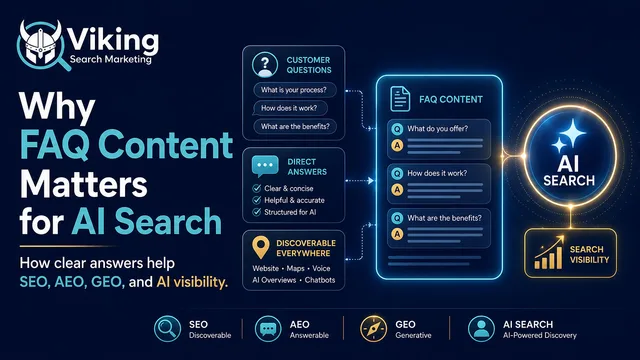
FAQ content: the actual questions and answers on your page. Still genuinely useful, for customers, for regular SEO, and for AEO and AI search visibility.
Clear answers remain useful for customers and can help explain a business to search systems. Google does not require FAQPage markup or a particular question-and-answer format for AI search. See Google’s AI search guidance.
What to Actually Do About It
Don't spend time adding new FAQPage schema for the sake of the old rich result. It won't produce anything anymore.
If you already have FAQPage schema on your site, there's no urgent need to rip it out. It's not causing harm, it's just no longer doing the one thing it used to do.
Keep writing clear, direct-answer FAQ content on your service pages. That work still pays off for AEO, GEO, and for customers who land on your site with a specific question.
Use structured data that matches your visible content and an eligible search feature. Product and review markup have specific requirements; a LocalBusiness block alone does not promise a rich result. Google does not award review stars for self-serving reviews about an organization or local business. See Google’s review-snippet requirements.
The Bigger Pattern Worth Remembering
This is a good reminder of something we've said before: chasing a specific technical format is rarely the durable strategy. The format changes. Google has added and removed rich result types before and will again. What holds up is the underlying substance, content that actually answers what a real customer is asking. Google's own generative AI guidance makes the same point directly: structured data markup was never mandatory for AI features to begin with. It helps with certain rich results when those features exist. It was never the thing doing the heavy lifting.
If you want a check on which structured data on your site is still doing something useful versus which is legacy, that’s a quick thing to look at in a Free Visibility Snapshot, or as part of a full SEO Audit and Strategy.
Related reading: Why FAQ Content Matters for AI Search, SEO and AEO for Small Businesses: How They Work Together, and How to Get Cited by AI Overviews and ChatGPT: A Practical GEO Checklist.