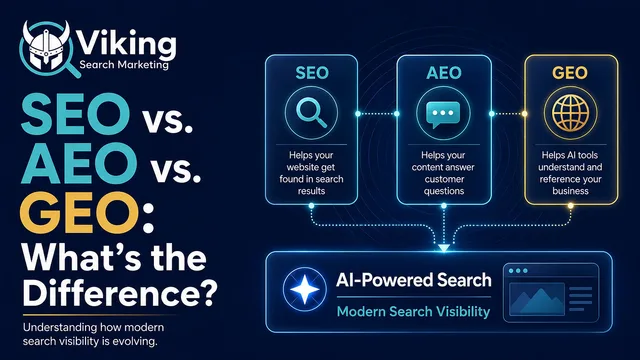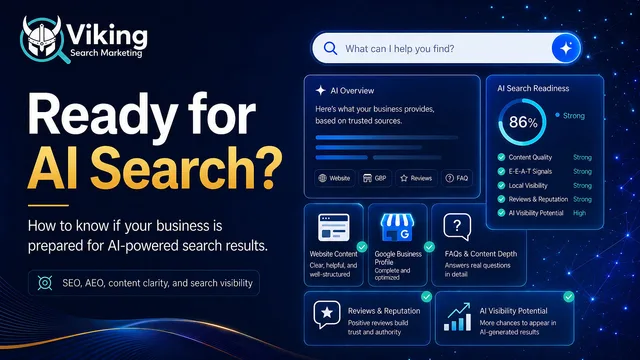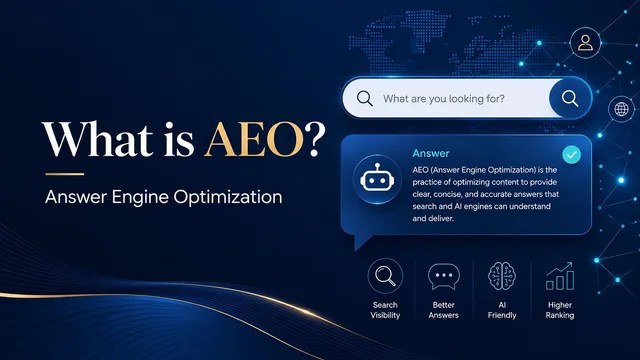
If you've searched for "SEO and AEO for small business" and come away more confused than when you started, you're not alone. Most explanations treat SEO and answer engine optimization as two separate strategies to pick between. They're not. AEO builds directly on top of SEO, and skipping the SEO half leaves AEO with nothing to stand on.
SEO Is Still the Foundation
Google has said this in plain language. In a resource Google Search Central published for site owners in 2026, the company states that "the best practices for SEO continue to be relevant because our generative AI features on Google Search are rooted in our core Search ranking and quality systems." Before a page can show up in an AI Overview or an AI Mode answer, it has to already be doing the fundamentals right: technically crawlable, properly indexed, fast enough to use, and genuinely relevant to what someone typed in.
For a small business, that foundation looks like:
A site Google can actually crawl and index without errors
Clear, accurate business information: hours, services, service area, and pricing structure where relevant
A complete, actively managed Google Business Profile
Content that answers real customer questions instead of keyword-stuffed service pages
Basic trust signals: reviews, testimonials, and a site that looks credible on both desktop and mobile
These are standard SEO foundations. AEO adds attention to how directly and accurately the content answers customer questions. It can support clarity, but an optimization practice does not decide whether a search system will quote the page.
What AEO Actually Adds
Answer engine optimization is the practice of shaping content so it can be lifted cleanly into a direct answer, whether that's a featured snippet, an AI Overview, Google's AI Mode, or a chatbot summarizing the web for a user. The mechanics are less mysterious than they sound:
Write the actual answer near the top of the section, in plain language, before the supporting detail
Use headings that match how a real customer would ask the question
Keep one clear idea per paragraph or list instead of burying the answer in a wall of text
Keep your business's basic facts, name, location, services, hours, stated consistently everywhere they appear online
None of this requires rewriting a site in a special "AI voice" or restructuring content into rigid chunks. It just requires being direct.
The Myths Worth Ignoring
Google's own generative AI optimization guidance for site owners is unusually blunt about what does not matter. According to Google:
A special llms.txt file is not required
Breaking content into rigid "chunks" is not a ranking factor
There is no special "AI-optimized" writing style to adopt
Structured data markup is not mandatory for AI features, though it still helps with regular rich results
Google does not require llms.txt, special AI markup or rigid content chunks for its generative search features. A discovery file or integration endpoint should not be sold as an AI ranking signal. Focus on accessible, useful content and accurate business facts, as described in Google’s guidance.
A Practical Checklist for Small Businesses
Confirm your site is indexed and crawlable in Search Console’s coverage report
Keep your Google Business Profile complete and current: hours, services, photos, and posts
Answer real customer questions directly, in your own words, near the top of the relevant page or post
Use clear, descriptive headings that mirror how customers actually phrase questions
Keep name, address, phone, and service details consistent across your site, your Google Business Profile, and directories
Build genuine trust signals: real reviews, real testimonials, and transparent pricing structure where appropriate
Check Search Console's Generative AI performance report periodically to see whether your pages are appearing in AI-powered results, separate from your regular click data
One Strategy, Not Two
SEO and AEO work together: build sound technical foundations and answer the questions customers actually ask. Neither guarantees quotation in an AI answer. A Free Visibility Snapshot can identify initial gaps, while SEO Audit and Strategy and AI Search Optimization provide scoped support.
Related reading: What Is AEO and Why Does It Matter for Your Business?, SEO vs. AEO vs. GEO: What's the Difference?, and Is Your Business Ready for AI Search?.