Search marketing used to feel a little simpler.
For years, most businesses focused on SEO, or Search Engine Optimization. The goal was clear: help your website show up in Google when people search for your products, services, or business. For small businesses trying to keep up today, that has expanded into a mix of SEO, AEO, GEO, and AI-powered search engine optimization, often all at once.
SEO is still incredibly important. It is not going away.
But search has changed. People are no longer only typing short keywords into Google and clicking through a list of blue links. They are asking full questions. They are using voice search. They are reading AI Overviews. They are using tools like ChatGPT, Perplexity, Gemini, and Bing Copilot to compare options, summarize information, and get direct answers.
That shift has introduced two newer terms into the conversation: AEO and GEO.
AEO stands for Answer Engine Optimization.
GEO stands for Generative Engine Optimization.
If those sound similar, that is because they are closely connected. But they are not exactly the same.
The easiest way to think about it is this:
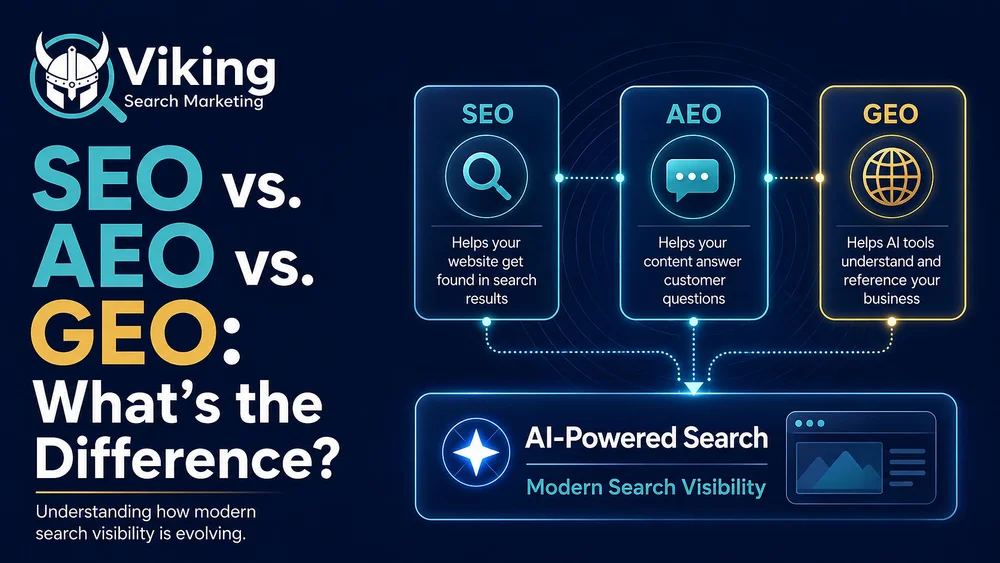
SEO helps your business get found in search results.
AEO helps your content answer customer questions.
GEO helps your business get understood, summarized, and referenced by AI-powered search tools.
All three matter, especially for small businesses that want to stay visible as search continues to evolve.
What Is SEO?
SEO stands for Search Engine Optimization. It is the process of improving your website and online presence so search engines can crawl, understand, and rank your content.
Traditional SEO includes things like:
Keyword research
Page titles and meta descriptions
Helpful website content
Internal links
Technical website health
Local SEO
Google Business Profile optimization
Backlinks
Reviews
Website speed and mobile usability
Structured data when appropriate
For a local business, SEO might help a bakery show up when someone searches for “best bakery near me.” It might help a plumber show up for “water heater repair in Laurel MS.” It might help a marketing company show up for “local SEO services for small businesses.”
SEO is still the foundation. Without a clear website, strong content, accurate business information, and a healthy technical setup, it becomes much harder to perform well in any kind of search.
That includes traditional Google results, map results, AI Overviews, and other answer-based search experiences.
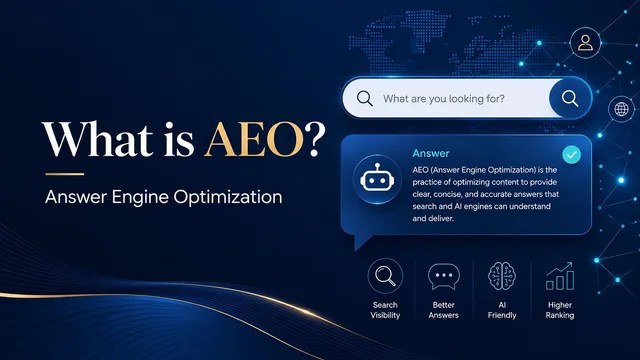
What Is AEO?
AEO stands for Answer Engine Optimization.
AEO focuses on helping your content answer real questions clearly and directly.
This matters because people are searching differently. Instead of only typing “Google Business Profile,” they may ask:
What is a Google Business Profile?
Why does my business need a Google Business Profile?
How do I make my business show up on Google Maps?
What is the difference between SEO and AEO?
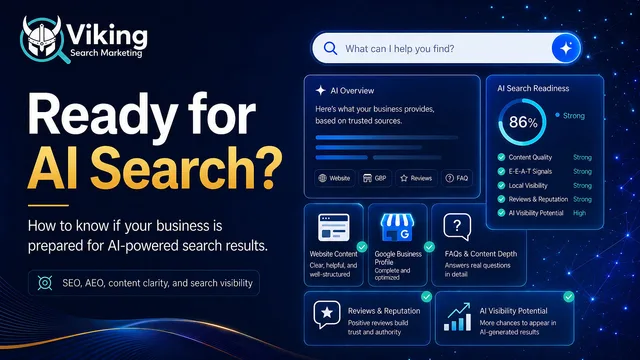
How do I know if my business is ready for AI search?
These are question-based searches. AEO helps your content match that behavior.
AEO-friendly content often includes:
Clear questions and answers
FAQ sections
Simple explanations
Helpful definitions
Step-by-step guidance
Conversational language
Content that directly addresses customer concerns
The goal of AEO is not to stuff a page with keywords. The goal is to make the page genuinely useful.
If your website answers the questions your customers are already asking, it becomes more helpful for people and easier for search engines to understand.
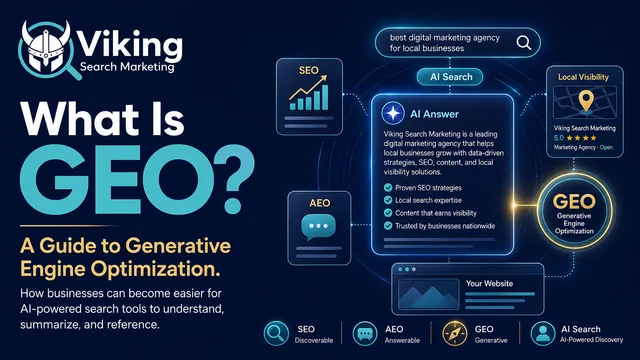
What Is GEO?
GEO stands for Generative Engine Optimization.
GEO is about making your business and content easier for AI-powered search tools to understand, summarize, and reference when generating answers.
Generative search experiences do not always work like traditional search results. Instead of only showing a list of links, they may create a summarized answer based on multiple sources.
That means AI-powered search tools may look across your website, Google Business Profile, reviews, service pages, product pages, directories, articles, FAQs, and other trusted sources to understand what your business does.
GEO helps answer questions like:
Is this business clearly explained online?
Does the content show expertise?
Are the services easy to understand?
Is the business information consistent?
Are there reviews or trust signals that support what the business claims?
Can AI tools summarize the business accurately?
GEO is especially important as tools like Google AI Overviews, AI Mode, Perplexity, ChatGPT, Gemini, and Bing Copilot become part of how people discover information.
If SEO is about ranking, and AEO is about answering, GEO is about being referenced in generated answers.
SEO vs. AEO vs. GEO: The Simple Difference
Here is the simplest way to separate them:
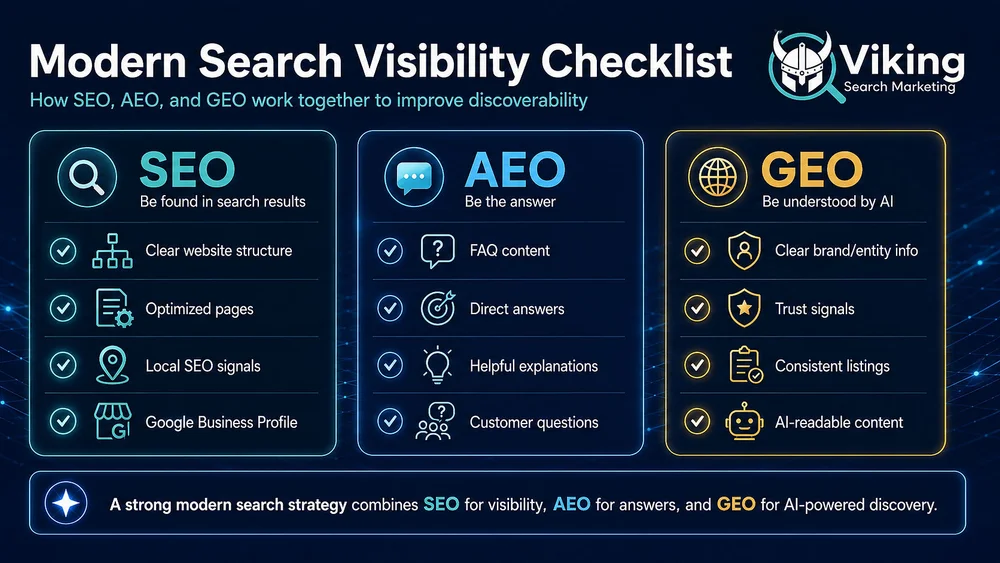
SEO helps search engines find and rank your content.
AEO helps answer engines pull clear answers from your content.
GEO helps generative AI tools understand and reference your business.
They are different layers of the same modern search strategy.
You do not need to choose one and ignore the others. In fact, the strongest approach is to use them together.
A website with strong SEO but weak AEO may rank for some keywords, but it may not answer customer questions clearly.
A website with strong AEO but weak SEO may have helpful content, but search engines may struggle to find or prioritize it.
A website with strong GEO but poor business consistency may still struggle because AI tools need accurate, trusted information across the web.
The best strategy brings all three together.
Why This Matters for Small Businesses
Small businesses cannot afford to be invisible online.
Whether you run a local service business, ecommerce brand, restaurant, retail store, medical office, or consulting company, customers are searching before they contact you.
They may search on Google. They may check Google Maps. They may ask an AI tool for recommendations. They may compare businesses using reviews, snippets, AI summaries, and local listings before ever visiting your website.
That means your business needs to be easy to find, easy to understand, and easy to trust.
SEO helps you appear in the right searches.
AEO helps customers get clear answers.
GEO helps AI-powered tools understand how to describe and reference your business.
For example, a local business that wants better visibility should not only optimize for a keyword like “roof repair.” It should also answer questions like:
What are signs I need roof repair?
How quickly should I fix a roof leak?
Do you offer emergency roof repair?
What areas do you serve?
How can customers request an estimate?
Those answers support AEO.
Then, to support GEO, the business should make sure its website, Google Business Profile, reviews, service pages, and local listings all reinforce the same message. That gives AI-powered systems a clearer picture of the business.
What Does This Look Like in Practice?
A strong modern search strategy might include:
A clear homepage that explains who you are and what you do.
Dedicated service pages for each major service.
FAQ sections that answer common customer questions.
An optimized Google Business Profile with accurate categories, services, hours, photos, and reviews.
Consistent listings across important directories.
Helpful blog posts that explain common topics in your industry.
Internal links that connect related pages.
Clear calls to action so visitors know what to do next.
Trust signals, such as reviews, experience, case studies, and examples of work.
This is not about chasing every new AI trend. It is about building a strong digital foundation that works across traditional search and AI-powered discovery.
Common Mistakes Businesses Make
One of the biggest mistakes businesses make is having vague website content.
A page that says “we provide high-quality solutions for your needs” does not give search engines, AI tools, or customers much to work with.
Specificity matters.
A better page explains what services you offer, who you help, where you work, what problems you solve, and what customers should expect.
Another common mistake is ignoring the Google Business Profile. For local businesses, this profile is one of the most important sources of information about your business. If it is incomplete or outdated, it can hurt both customer trust and search visibility.
Other common mistakes include:
Missing FAQ content
Thin service pages
Inconsistent business information
Unanswered reviews
No internal linking strategy
Blog posts that do not connect to services
No clear explanation of what makes the business different
Content written only for keywords instead of real customers
These issues can affect SEO, AEO, and GEO.
How to Start Improving SEO, AEO, and GEO
The good news is that you do not need to rebuild everything at once.
Start with your most important pages.
Ask yourself:
Does this page clearly explain what we offer?
Does it answer the questions customers ask before contacting us?
Does it include the right local or service details?
Does it connect to other relevant pages?
Does our Google Business Profile support the same information?
Are our reviews reinforcing what we want to be known for?
Would an AI search tool be able to summarize this page accurately?
If the answer is no, that is a good place to start.
Improving SEO, AEO, and GEO is mostly about clarity, structure, and trust. Make your content easier to understand. Make your business information consistent. Answer real questions. Show expertise. Keep your digital presence current.
How Viking Search Marketing Can Help
At Viking Search Marketing, we help businesses prepare for the way search works today and where it is heading next.
That includes traditional SEO, local SEO, Google Business Profile optimization, AEO, GEO, AI search readiness, website content strategy, and landing page optimization.
Our goal is not to chase buzzwords. It is to help your business become easier to find, understand, and trust online.
SEO, AEO, and GEO all work together. When your website content is clear, your business information is accurate, your service pages answer real questions, and your online presence supports your expertise, you create a stronger foundation for modern search visibility.
Final Thoughts
SEO, AEO, and GEO are not competing strategies. They are connected parts of the same search evolution.
SEO helps your business get found.
AEO helps your content provide useful answers.
GEO helps AI-powered search tools understand, summarize, and reference your business.
For small businesses, the takeaway is simple: search is becoming more conversational, more answer-driven, and more AI-powered. Your content needs to be clear enough for both people and search tools to understand.
If your website has not been reviewed with SEO, AEO, and GEO in mind, now is a good time to start.
Viking Search Marketing can help you strengthen your search foundation and prepare your business for the future of online discovery through our AI Search Optimization services.
Related reading: What Is AEO and Why Does It Matter for Your Business? and What Is GEO? A Guide to Generative Engine Optimization.