Search is changing...... again.
For years, businesses have focused on SEO, or Search Engine Optimization, to help their websites appear in Google search results. More recently, many businesses have started learning about AEO, or Answer Engine Optimization, which focuses on creating content that answers customer questions clearly.
Now another term is becoming more important: GEO.
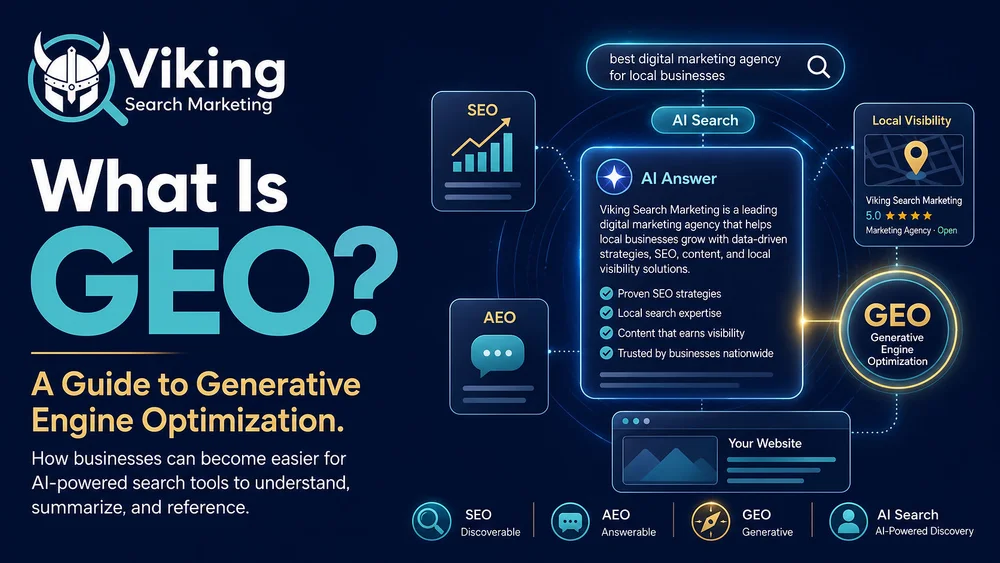
GEO stands for Generative Engine Optimization. It is the process of making your business, website, and content easier for AI-powered search tools to understand, summarize, and reference when generating answers.
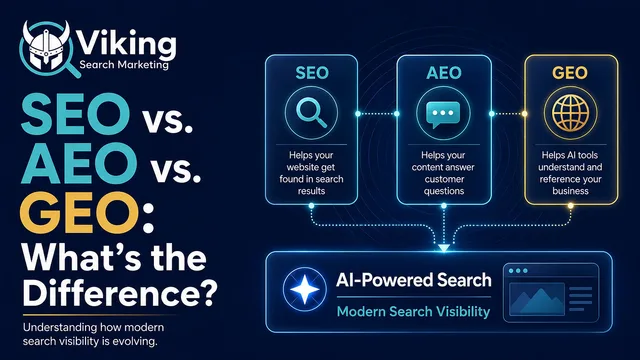
In simple terms, SEO helps your website show up in search results. AEO helps your content answer specific questions. GEO helps your business become more visible in AI-generated responses.
For small businesses, local businesses, service providers, and ecommerce brands, this matters because customers are no longer only searching through traditional search results. They are using AI-powered tools to ask questions, compare options, get recommendations, and make decisions faster.
What Is Generative Engine Optimization?
Generative Engine Optimization is the practice of optimizing your online presence for generative AI search experiences.
These experiences include tools and features that generate answers instead of only showing a list of links. That may include AI search engines, chatbot-style search tools, AI
Overviews, AI assistants, and other answer-based platforms.
When someone asks a question, a generative engine may summarize information from multiple sources and provide a direct response. It may also include brand names, businesses, products, service providers, reviews, locations, and links to supporting sources.
That is where GEO comes in.
The goal of GEO is to help AI-powered systems clearly understand:
Who your business is
What you offer
Where you are located
Who you serve
What makes you trustworthy
What questions your content answers
Why your business may be relevant to a search
GEO is not about tricking AI tools. It is about making your digital presence clear, helpful, consistent, and easy to understand.
GEO vs. SEO vs. AEO
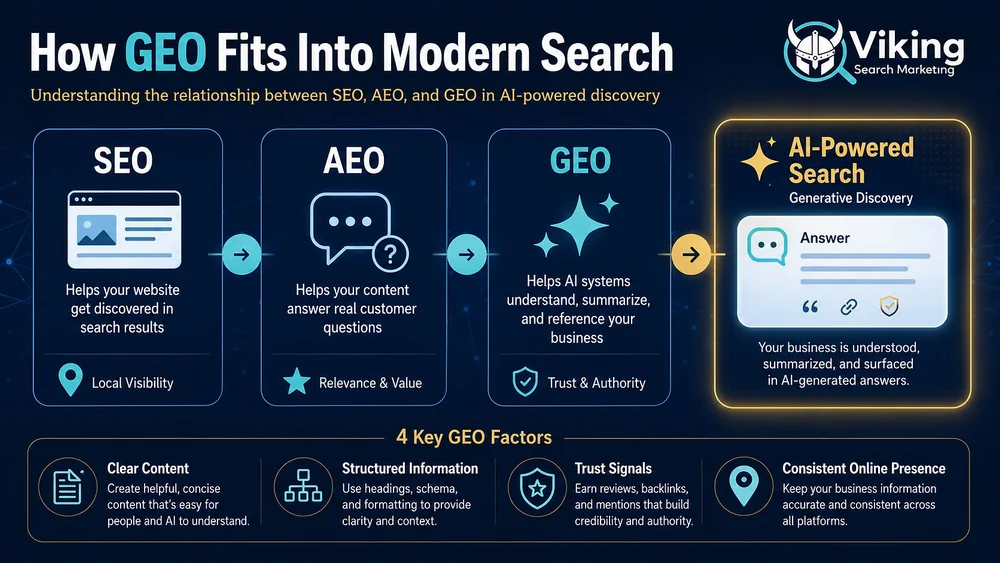
SEO, AEO, and GEO are closely connected, but they are not exactly the same.
SEO focuses on improving visibility in traditional search results. This includes website structure, keywords, page titles, metadata, internal links, technical SEO, local listings, backlinks, and high-quality content.
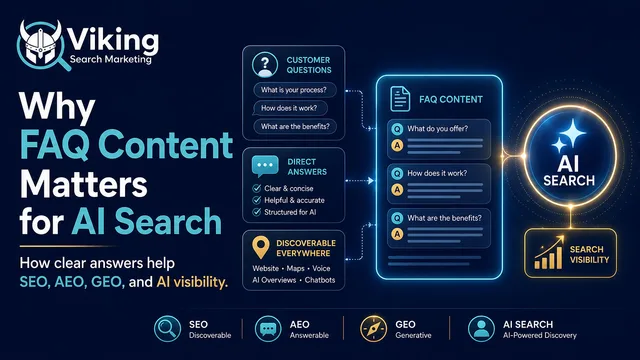
AEO focuses on answering specific questions clearly. This includes FAQ content, conversational search terms, direct answers, and helpful explanations that match how people ask questions.
GEO focuses on how generative AI systems understand and use your content when creating answers. This includes clarity, topical authority, trust signals, structured information, brand mentions, consistency across the web, and content that can be summarized accurately.
A simple way to think about it is this:
SEO helps you rank.
AEO helps you answer.
GEO helps you get referenced.
All three matter. A strong GEO strategy still needs the foundation of good SEO and AEO.
Why GEO Matters Now
People are changing the way they search.
Instead of typing short phrases like “local SEO company,” they may ask:
What is the best way to make my business show up in AI search?
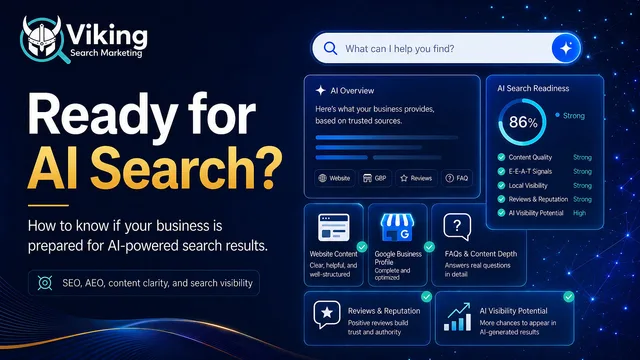
How do I know if my website is ready for AI-powered search?
What local SEO company can help with Google Business Profile optimization?
Which skincare brands make tallow balm for men?
What businesses near me offer the service I need?
These are more conversational searches. They often require an answer, not just a list of links.
AI-powered search tools are designed to respond to that behavior. They can summarize information, compare options, explain topics, and recommend sources. If your business is not clearly represented online, those tools may have a harder time understanding where you fit.
For businesses, GEO is becoming important because visibility is no longer only about ranking on page one. It is also about whether your business can be understood and included when AI tools generate answers.
What Makes Content GEO-Friendly?
GEO-friendly content is clear, specific, helpful, and easy to verify.
It does not rely on vague marketing language. It explains things in a way that both people and AI systems can understand.
For example, a weak service page might say:
“We provide complete digital solutions for modern brands.”
That sounds polished, but it is vague.
A stronger GEO-friendly version would say:
“Viking Search Marketing helps small businesses improve online visibility through SEO, local SEO, Google Business Profile optimization, AEO, AI search readiness, and website content strategy.”
That is clearer. It tells people and search tools what the business actually does.
Good GEO-friendly content often includes:
Clear explanations of services
Specific product or service details
Helpful FAQ sections
Strong internal linking
Consistent business information
Trust signals and real expertise
Natural language that matches how people search
Structured content with clear headings
Accurate descriptions across listings and profiles
Content that answers real customer questions
The goal is to remove confusion.
If your content is vague, outdated, thin, or inconsistent, AI-powered tools may not understand your business well enough to mention it confidently.
GEO and Local Businesses
GEO is especially important for local businesses.
When someone asks an AI-powered search tool for recommendations, local options, or service providers nearby, the tool may look at many signals. These can include your website, Google Business Profile, reviews, local listings, directories, service pages, FAQs, and other mentions across the web.
That means your business needs a strong and consistent digital footprint.
For a local restaurant, GEO-friendly content may include details like cuisine, location, popular menu items, atmosphere, outdoor seating, reservation options, and customer reviews.
For a home service business, it may include service areas, specific services, emergency availability, licensing information, FAQs, and customer trust signals.
For a product-based business, it may include product descriptions, ingredients, use cases, target audience, FAQs, and internal links to related products or blog content.
For a local SEO agency, it may include clear service pages, case studies, educational articles, client examples, and helpful explanations of SEO, AEO, GEO, and AI search visibility.
The more complete and consistent your information is, the easier it is for AI-powered systems to understand what your business should be associated with.
GEO Is Not Just About Your Website
Your website is important, but GEO is bigger than your website alone.
AI-powered search tools may pull information from many places. That means your broader online presence matters too.
A strong GEO foundation may include:
A clear and optimized website
A complete Google Business Profile
Consistent local listings
Customer reviews that mention real services
Helpful blog content
Case studies
FAQs
Social profiles
Product pages
Directory listings
Brand mentions across trusted websites
This is one reason local SEO and GEO work well together.
If your website says one thing, your Google Business Profile says another, and your listings are outdated, that creates confusion. If your information is consistent everywhere, it builds a clearer picture of your business.
Common GEO Mistakes Businesses Make
Many businesses are not ready for GEO because their online presence is too vague.
Some common mistakes include:
Service pages that do not explain what the business actually does
Missing FAQ sections
Thin product descriptions
Outdated Google Business Profile information
Inconsistent name, address, and phone number details
No clear service area
Few trust signals
No helpful blog content
Reviews that are ignored
No internal linking strategy
Website copy written only for keywords, not real questions
Another common mistake is assuming that AI tools will automatically understand your business.
They might not.
AI search tools need clear information. If your business does not explain its services, answer customer questions, and build trust across the web, it may be harder for those tools to include you in generated answers.
How Businesses Can Start Improving GEO
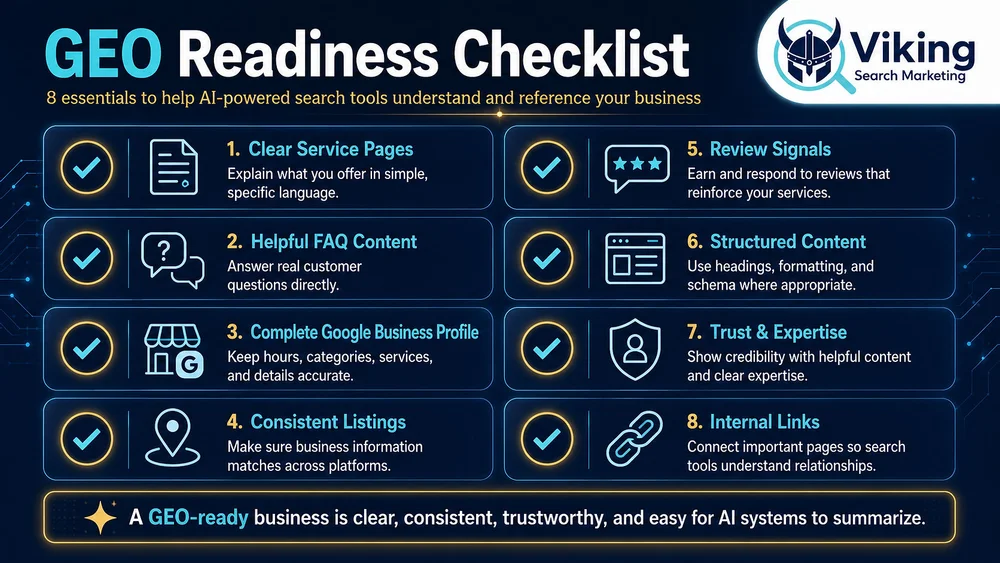
The good news is that GEO does not require you to throw out your existing SEO strategy.
It builds on the fundamentals.
Start by reviewing your website and asking:
Does each important page clearly explain what we offer?
Do we answer the questions customers ask before contacting us?
Are our services described in plain language?
Is our Google Business Profile complete and accurate?
Do our reviews support the services we want to be known for?
Do our product or service pages include enough detail?
Do we have helpful FAQs?
Is our business information consistent across the web?
Do we have content that demonstrates expertise?
If the answer is no, those are good starting points.
To improve GEO, businesses should focus on clarity, consistency, and usefulness. Write content that explains what you do. Add FAQ sections. Strengthen service pages. Keep local listings accurate. Respond to reviews. Create content around real customer questions. Build pages that can be understood by both people and AI-powered search tools.
How Viking Search Marketing Can Help
At Viking Search Marketing, we help businesses prepare for the future of search without losing sight of the fundamentals.
That means combining traditional SEO, local SEO, AEO, and GEO into a clear strategy that helps businesses get found, understood, and trusted online.
We help businesses improve:
Website content
Google Business Profile optimization
Local SEO
Landing page strategy
Product and service page structure
FAQ content
AI search readiness
Answer Engine Optimization
Generative Engine Optimization
Search visibility audits
GEO is not about chasing a trend. It is about making sure your business is clear enough to be understood in a search world that is becoming more conversational and AI-powered.
Final Thoughts
GEO, or Generative Engine Optimization, is about helping your business become easier for AI-powered search tools to understand, summarize, and reference.
SEO is still important. AEO is still important. But GEO adds another layer to the modern search strategy.
If SEO helps your business rank, and AEO helps your content answer questions, GEO helps your business become part of AI-generated discovery.
For small businesses, this is a major opportunity. The businesses that explain themselves clearly, answer real customer questions, maintain accurate information, and build trust across the web will be better prepared for the way search is changing.
If your website has not been reviewed for GEO, now is the time to start.
Viking Search Marketing can help you strengthen your SEO foundation, improve AI search readiness, and build content that makes your business easier to find, understand, and trust through our AI Search Optimization services.
Related reading: SEO vs. AEO vs. GEO: What's the Difference? and Why Does Every AI Button Use a Sparkle Icon?.