
Google has spent the past few years transforming its search results with AI Overviews, AI Mode, and other generative experiences. Until now, website owners could see the effects of that shift without having a clear way to isolate where their sites were appearing inside it.
That is beginning to change.
Google Search Console now includes a dedicated Generative AI features performance report. The interface still carries a Beta label, but Google says the reporting was rolled out to websites worldwide as of August 31, 2026.
For search marketers and business owners, this is a welcome development. It does not answer every question about AI search performance, but it gives us something the industry has needed: first-party visibility data directly from Google.
What Changed in Google Search Console?
Google has long included activity from AI Overviews and AI Mode within the broader Web search data in Search Console. The problem was that marketers could not isolate that activity from traditional search performance.
The new report provides a separate view of impressions generated when links to a website appear within Google's generative AI features. It currently includes AI Overviews and AI Mode in Search, with separate generative AI reporting also available for Discover where applicable.
The report can be viewed by:
Page
Country
Device
Date
That makes it possible to see which URLs are earning the most AI visibility, where those impressions originate, how mobile and desktop visibility compare, and whether performance changes over time.
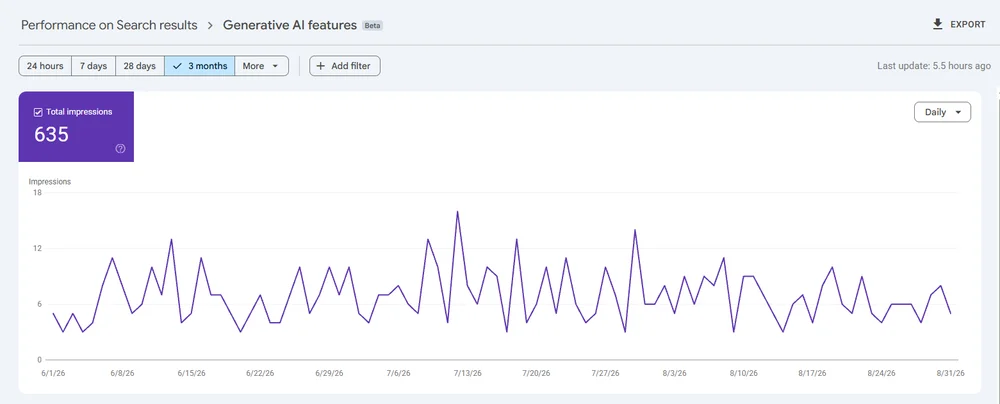
An anonymized example of the new Generative AI features report in Google Search Console. The report currently focuses on impressions and remains labeled Beta in the interface.
Why This Is a Meaningful Step Forward
AI search measurement has often depended on manual spot checks, third-party monitoring tools, and educated guesses. Those methods can still be useful, but none of them has the authority of Google's own reporting.
This update begins to move AI search visibility from anecdote to measurable performance data.
For the first time, a business may be able to confirm that a page is appearing in Google's generative experiences even when that visibility does not produce an obvious click. That distinction matters because AI-assisted search can influence awareness and consideration before a user ever visits a website.
It also gives content and SEO teams a better starting point for pattern recognition. If certain service pages, guides, case studies, or original research consistently earn generative AI impressions, that can help clarify what Google considers useful enough to surface in these experiences.
For businesses already investing in AI search optimization, the report creates a more credible baseline from which to monitor progress.
What Marketers Can Learn From the Report
The report is most useful when treated as a directional measurement tool rather than a complete attribution system.
Establish an AI visibility baseline
Businesses can record their current impression levels and monitor whether generative visibility expands over time. This is particularly useful now, while AI-powered search behavior and Google's reporting are both evolving quickly.
Identify pages that earn AI exposure
The Pages view can reveal which URLs appear most frequently in generative experiences. Marketers can then study what those pages have in common: original expertise, clear structure, useful comparisons, strong supporting evidence, first-hand experience, or media that adds context.
Compare countries and devices
Country and device breakdowns can reveal where AI search exposure is developing most quickly. For businesses serving multiple markets, that may help surface regional content opportunities or differences in how audiences encounter the brand.
Watch trends after meaningful changes
The report can help teams observe what happens after improving a page, expanding a topic, adding original evidence, strengthening internal links, or clarifying a brand's expertise. It cannot prove that one change caused an increase, but it can add another useful signal to the evaluation.
What the Report Still Does Not Tell Us
Google is pulling back the curtain, but only partially.
The dedicated Generative AI features report currently emphasizes impressions. It does not provide the complete set of metrics marketers would need for full performance analysis.
Among the most important gaps:
The report does not show the exact searches, prompts, or follow-up questions that triggered the appearance.
It does not clearly separate AI Overview impressions from AI Mode impressions.
It does not show clicks, click-through rate, or average position in this dedicated view.
It does not explain where or how prominently a page was cited within an AI response.
It does not connect an impression directly to a lead, sale, or other conversion.
This means an AI impression should not automatically be treated as a business result. It is evidence of visibility—not necessarily engagement or value.
The next step is to compare Search Console trends with website engagement and conversion data. Even then, marketers should be careful about claiming precise attribution when the connecting data is not available.
That is why a broader SEO audit and strategy should evaluate AI visibility alongside technical health, content quality, traditional rankings, local presence, engagement, and conversions.
This Does Not Create a New Kind of SEO
The appearance of a new report will inevitably lead to new optimization claims. Some will make AI search sound like a completely separate discipline with a secret technical formula.
Google's own guidance is more grounded. Pages still need to be indexed and eligible to appear in Search. Helpful, reliable, people-first content remains central. Google says there is no special schema or AI-specific file required for inclusion in AI Overviews or AI Mode.
The fundamentals still matter:
Make important content crawlable and indexable.
Explain topics clearly and organize pages for readers.
Publish original, non-commodity information based on real expertise or experience.
Keep structured data consistent with visible page content.
Use relevant images and video where they improve the page.
Strengthen internal links so important resources are easy to discover.
Provide a good experience after the visitor reaches the site.
AI search optimization builds on those foundations. It does not replace them. Our overview of Answer Engine Optimization explains how clear, answer-focused content fits into that larger search strategy.
A Better Conversation About AI Search Performance
Perhaps the most encouraging part of this release is what it signals.
Publishers, businesses, and search professionals have repeatedly asked for more transparency as Google incorporates generative AI into Search. A dedicated first-party report shows that Google recognizes the need for website owners to understand how their content participates in these experiences.
The report is not complete, and it should continue to improve. Query-level context, feature segmentation, clicks, and stronger connections to downstream behavior would make the data significantly more actionable.
Still, this is a constructive first step. Better reporting gives businesses a more informed way to evaluate AI visibility, invest in useful content, and avoid making strategy decisions based entirely on screenshots or speculation.
What Businesses Should Do Next
If the Generative AI features report is available in your Search Console property, start simple:
Record your current impression baseline.
Review which pages receive the most visibility.
Compare performance by device and country.
Look for sustained trends rather than reacting to individual daily changes.
Compare visible pages with engagement and conversion data in your analytics platform.
Keep investing in original, useful content instead of chasing an imagined AI shortcut.
If the report is not visible, that does not necessarily indicate a problem. Google notes that a property may not show the report when it has not accumulated enough generative AI impressions.
Search is changing quickly, but the goal remains familiar: create a trustworthy digital presence that people and search systems can understand, use, and recommend.
Viking Search Marketing helps small businesses evaluate traditional search performance, AI search readiness, content structure, and measurement as one connected visibility strategy. Request a free visibility snapshot to see where your strongest opportunities may be.