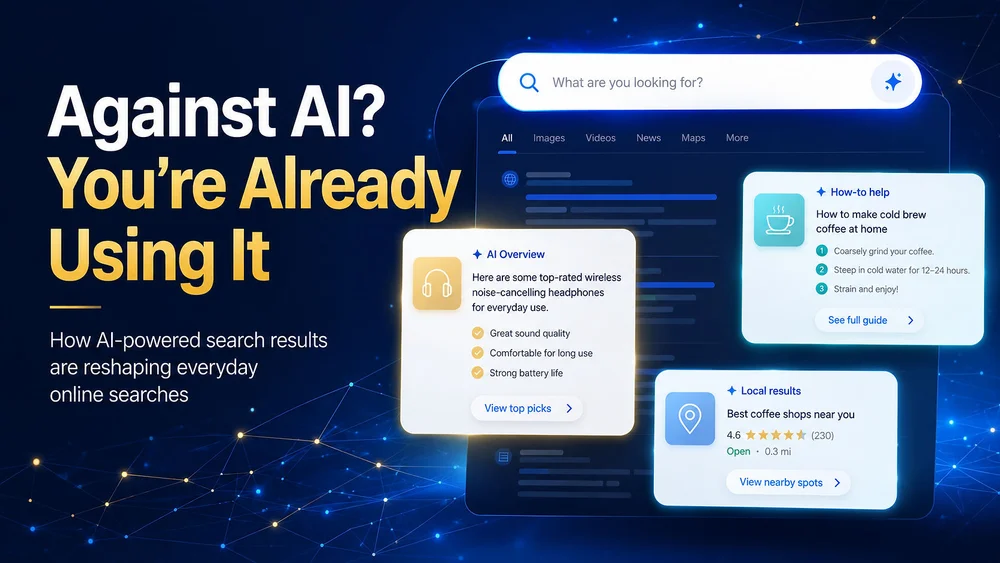
Artificial intelligence can be a polarizing topic.
Some business owners are excited about it. Others are skeptical. Some are tired of hearing about it altogether. That hesitation is understandable. AI has been hyped heavily, and not every use of it is helpful, accurate, or necessary.
But whether you are fully embracing AI or trying to avoid it, the reality is this: you are probably already using it every time you search online.
You may not be opening ChatGPT. You may not be asking Gemini to write something. You may not be using an AI tool in your business. But if you are searching on Google, Bing, or another major search engine, AI is already part of your online experience.
AI-powered search results are no longer something that may happen in the future. They are already showing up in everyday searches. They are helping summarize answers, recommend businesses, organize information, compare options, and answer questions directly on the search results page.
For businesses, this matters. If your customers are using AI-powered search results, your business needs to understand how those results work and how to be visible in them.
AI Search Is Already Part of Everyday Search
For years, search engines have used artificial intelligence in the background. Google and Bing have long used machine learning to understand search intent, rank results, identify spam, interpret language, and connect users with relevant information.
What has changed is that AI is now becoming more visible.
Instead of only giving users a list of links, search engines are increasingly generating answers. They may summarize information from multiple sources, recommend products, compare businesses, answer how-to questions, or organize results into categories.
That means a person searching online may get an AI-generated answer before they ever click a website.
This is easy to see in normal searches.
For example, a search like “other books like Project Hail Mary” can generate an AI Overview that recommends similar books and explains why those books match the searcher’s interest. It may identify patterns like hard science, high-stakes survival, humor, and problem-solving, then recommend books based on those themes.
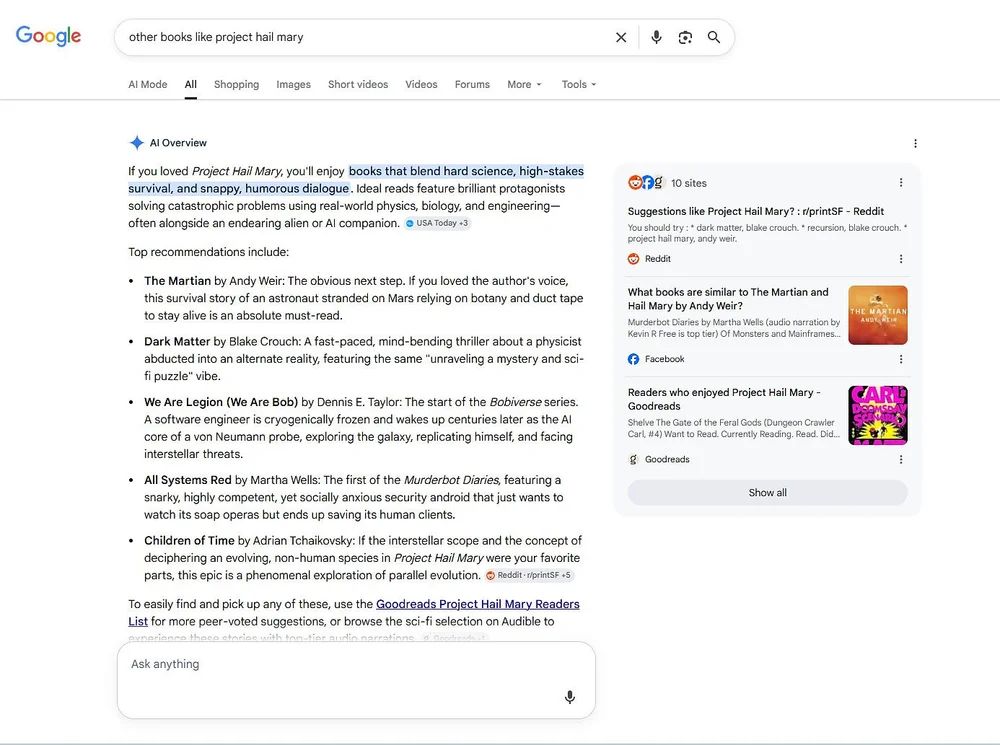
That is not just a list of search results. That is an AI-assisted answer.
A search like “how to hard reset iPhone” can also produce an answer directly in the results, walking the user through steps before they click through to a website.
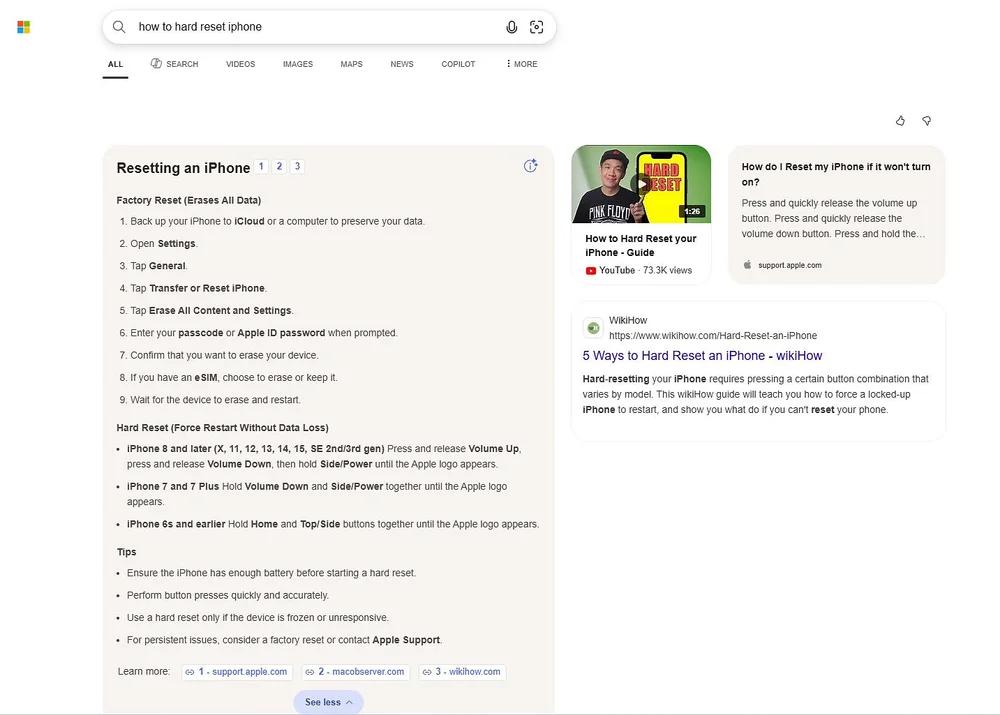
Again, this is not a future concept. It is already happening. Search engines are becoming answer engines.
From SGE to AI Overviews
Google began publicly testing generative AI in Search through Search Labs in May 2023. At that time, it was called Search Generative Experience, or SGE. Google described it as a way to use generative AI to help users understand a topic faster, see key information, and ask follow-up questions within Search.
In May 2024, Google expanded the experience under the name AI Overviews. Google announced that AI Overviews would begin rolling out to users in the United States, with plans to bring the experience to more people over time.
That shift was important. SGE started as an experiment. AI Overviews brought the concept into regular search results for a much larger audience.
And since then, AI in search has only become more common.
These screenshots show exactly where search is heading. Whether someone is looking for book recommendations, a how-to answer, a local restaurant, a coffee shop, or a local service provider, search engines are increasingly trying to provide a complete answer instead of simply handing users a list of websites.
Yes, Early AI Search Had Some Funny Mistakes
Of course, AI search did not arrive perfectly.
When AI Overviews first rolled out more broadly, some of the mistakes became famous very quickly. One of the most talked-about examples involved an AI result suggesting that someone add glue to pizza sauce to help cheese stick to the pizza. Another widely shared example involved a strange answer about eating rocks. Business Insider covered these examples, including how some odd AI results appeared to pull from satire or joke content online.
These examples were funny, but they also highlighted a real issue. AI systems can misunderstand context. They can struggle with sarcasm. They can pull from low-quality sources. They can present information too confidently when the answer is weak, misleading, or taken from the wrong kind of source.
Google addressed this shortly after the viral examples spread. Google said that some “odd, inaccurate or unhelpful AI Overviews” did appear, and explained that the issues often came from misinterpreting strange queries, sarcastic forum content, satire, or limited information on unusual topics.
That is important context.
AI search is not magic. It is not perfect. It still needs scrutiny. Users should still think critically, check sources, and avoid blindly trusting every answer.
But it is also important to recognize how much the experience has improved.
AI Search Has Improved Quickly
The early funny examples were real enough to get attention, but they do not represent the full picture of where AI search is today.
Google said it made more than a dozen technical improvements after reviewing early AI Overview issues. Those improvements included better detection for nonsensical queries, limits on satire and humor content, restrictions around user-generated content that could offer misleading advice, and additional triggering refinements for certain types of searches.
In other words, the technology is changing fast.
That does not mean AI search is flawless. It is not. But it does mean that businesses should not dismiss it based only on the earliest mistakes.
This pattern is common with new technology. It arrives imperfectly. People test it. Some examples go viral. The system improves. User behavior changes. Eventually, the new feature becomes part of everyday life.
That is what is happening with AI search.
You May Not Be Using AI, But Your Customers Are
This is the part business owners need to pay attention to.
You may be hesitant to use AI in your own business. You may prefer traditional marketing. You may not want AI writing your content. You may not be interested in chatbots. That is completely fine.
But your customers are still searching in an AI-influenced search environment.
They may search:
What is the best seafood restaurant near me?
Where can I get a wedding ring resized?
What books are like Project Hail Mary?
How do I hard reset my iPhone?
What is the best local SEO company for small businesses?
Which coffee shops are dog-friendly near me?
Why is my business not showing up on Google Maps?
These searches are specific, conversational, and answer-driven. Search engines are increasingly designed to respond to that kind of behavior.
If your business is not clearly represented online, AI-powered search experiences may have less to work with.
What AI Search Means for Local Businesses
For local businesses, this shift is especially important.
AI-powered search results often pull together information from websites, Google Business Profiles, reviews, directories, articles, menus, product listings, service pages, and other sources across the web.
That means your online presence needs to be clear, accurate, and complete.
If you are a restaurant, your website and listings should make it clear what type of food you serve, where you are located, what makes you different, what customers recommend, and whether you offer features like outdoor seating, reservations, takeout, delivery, waterfront dining, or family-friendly service.
If you are a jewelry store, your content should clearly mention specific services like ring resizing, jewelry repair, engagement rings, wedding bands, watch repair, custom jewelry, and in-house repairs if those services apply.
If you are a coffee shop, your content should clearly mention things customers search for, such as dog-friendly patio, local coffee, breakfast, Wi-Fi, parking, outdoor seating, and neighborhood location.
If you are a service business, your website should answer the questions customers ask before they call.
Search engines cannot recommend what they cannot understand.
SEO Still Matters, But It Is Expanding
Some people assume AI search means SEO is dead. That is not true.
SEO still matters because search engines still need to crawl, understand, evaluate, and rank information. Your website still needs strong content, useful pages, clear titles, optimized headings, internal links, local relevance, technical health, and trustworthy signals.
What is changing is the format of search results.
Instead of optimizing only for traditional blue links, businesses now need to think about how their content can support answer-based results.
That is where AEO comes in.
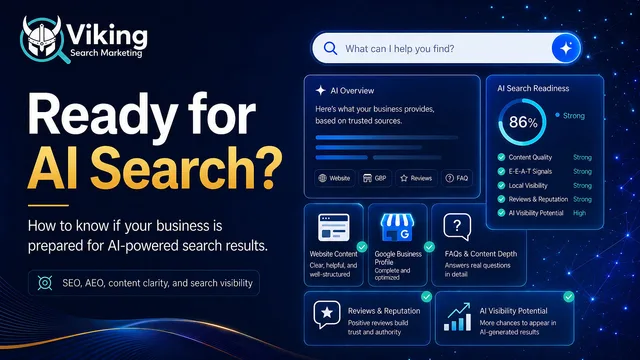
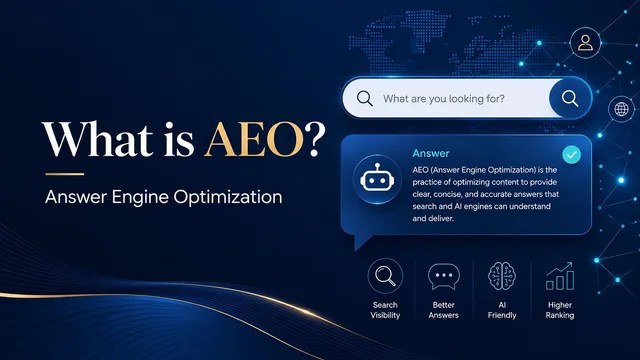
AEO stands for Answer Engine Optimization. It is the process of making your content easier for search engines and AI-powered tools to understand and use when generating answers.
Good AEO is not about tricking AI. It is about answering real customer questions clearly.
That includes:
Clear service descriptions
Helpful FAQ sections
Accurate business information
Strong Google Business Profile optimization
Consistent local listings
Review generation and review responses
Content that addresses common customer questions
Local details that explain where you serve customers
Trust signals that show experience and expertise
SEO helps you get found. AEO helps you become part of the answer.
What Businesses Should Do Now
Businesses do not need to panic, and they do not need to chase every new AI trend.
But they should start strengthening the foundation of their online presence.
Start by asking:
Is our website clear about what we do?
Do our service pages answer real customer questions?
Is our Google Business Profile accurate and complete?
Are our reviews recent and relevant?
Do customers mention our key services in reviews?
Are we responding to reviews professionally?
Do our listings match across the web?
Do we have FAQ content on important pages?
Do we clearly explain our location and service area?
Do we show why someone should choose us?
These are not just AI search tasks. These are good SEO and marketing fundamentals.
The difference is that they now matter in more places.
Your information may influence traditional search results, map rankings, AI Overviews, AI Mode results, voice search, and other answer-based search experiences.
You Do Not Have to Love AI to Prepare for It
Being cautious about AI is reasonable. AI can be wrong. It can be overused. It can create generic content. It can be used poorly.
Businesses should be thoughtful about how they use it.
But ignoring AI search completely is not a strong strategy.
You do not have to love AI to recognize that it is now part of how people find information online.
You do not have to replace your marketing strategy with AI.
You do not have to let AI write everything for you.
You simply need to understand that search is changing, and your business should be ready for the way customers are already searching.
How Viking Search Marketing Can Help
At Viking Search Marketing, we help businesses navigate the changing search landscape with a practical, grounded approach.
That includes traditional SEO, local SEO, Google Business Profile optimization, website content strategy, local listings, review guidance, and AEO-focused content.
Our goal is not to chase hype. It is to help businesses get found by real customers who are already searching for what they offer.
AI search is becoming part of that journey. Whether someone is comparing restaurants, looking for local services, asking a how-to question, or searching for recommendations, businesses need clear and trustworthy information online.
We help build that foundation.
Final Thoughts
You may be against AI. You may be skeptical of it. You may not be ready to fully embrace it.
But if you use modern search engines, you are already interacting with AI whether you realize it or not.
AI search results are already appearing in everyday searches, from book recommendations to iPhone troubleshooting to local business discovery. The early rollout had some funny and memorable mistakes, but the technology has improved quickly and continues to shape how people search.
For businesses, the takeaway is simple. Your customers are searching in a more conversational, answer-focused world. Your business needs to be clear, accurate, helpful, and easy to understand online.
That is not just the future of SEO. It is already happening.
What Small Businesses Should Do Next
You do not need to adopt every AI tool to prepare for AI-powered discovery. Start by making your website, business information, services, and expertise clear enough for both people and search systems to understand.
For a practical starting point, explore our AI Search Optimization Services, review our AI Solutions, or request a Free Visibility Snapshot to identify the strongest opportunities for your business.